My role
As the sole author of the project, I took it from design to implementation: data extraction, modeling, search, recommendations, evaluation and the API service.
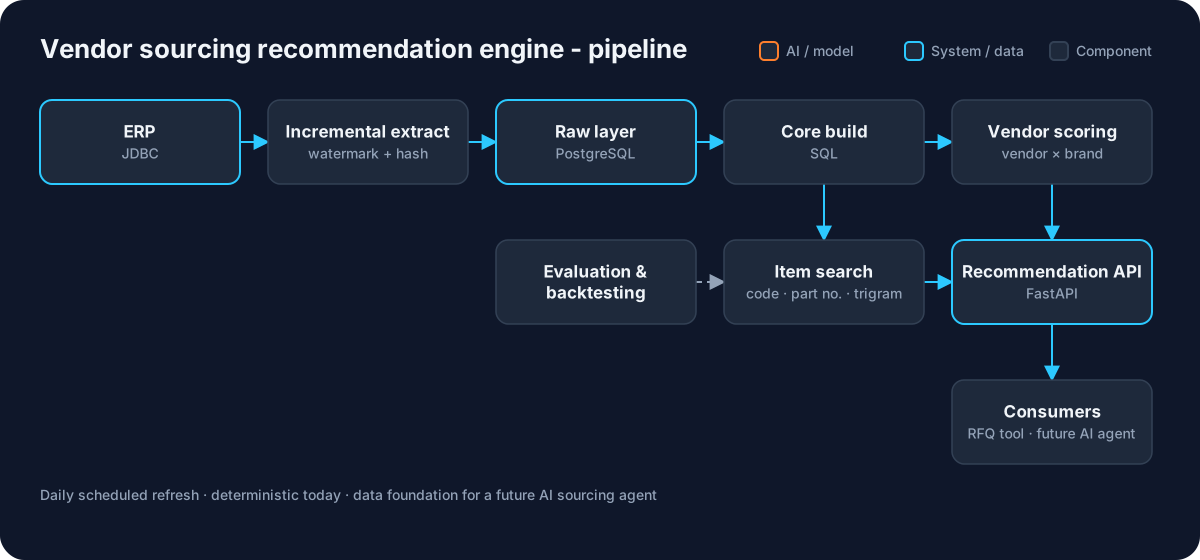
- Incremental extraction: Built the ERP extraction with watermarks and hash-based upserts into raw tables.
- Transformation layer: Designed the SQL layer that builds a consolidated core model and a vendor×brand performance score from historical activity.
- Canonicalization: Normalized items and brands so the same product can be found under different spellings.
- Search and recommendations: Developed the multi-step item search and the vendor recommendation logic.
- Evaluation: Wrote offline evaluation and backtesting commands to measure quality before any rollout.
- API service: Built a containerized FastAPI service with API-key authentication and request logging.
Key project features
- Multi-step item search: internal code → exact part number → fuzzy part number with trigram similarity → full-text.
- Vendor recommendations (primary and backups) with confidence and human-readable reasons.
- Daily scheduled refresh of the whole pipeline.
- Offline evaluation and backtesting commands.
- Currently deterministic (no ML or embeddings) and designed as the data foundation for a future AI sourcing agent, with embeddings and RAG planned.
Impact achieved
Deciding which vendors to ask for a quote no longer has to depend only on each buyer's individual knowledge. In an offline evaluation on a test environment (not production), the engine reached:
- Item search hit@1: 99.8% with brand + part number, 98.2% with part number only and 96.4% with a one-character typo.
- Recommendation backtest hit@1: 88.5% for previously purchased items.
- Search p50 latency of about 200 ms, over roughly 490k processed rows.
The project is in development and not yet deployed.
Technologies
| Technology | Use / Implementation |
|---|---|
| Python | Extraction, transformation orchestration and evaluation commands. |
| FastAPI | Recommendation and search API with API-key authentication. |
| PostgreSQL | Raw and core data layers, scoring and full-text search. |
| pg_trgm | Trigram similarity for fuzzy part number matching. |
| Docker | Containerization of the service. |
Project flow