My role
As a core contributor (the second-largest of five developers), I worked on the platform from its original bidirectional sync phase through its evolution into a shared integration layer.
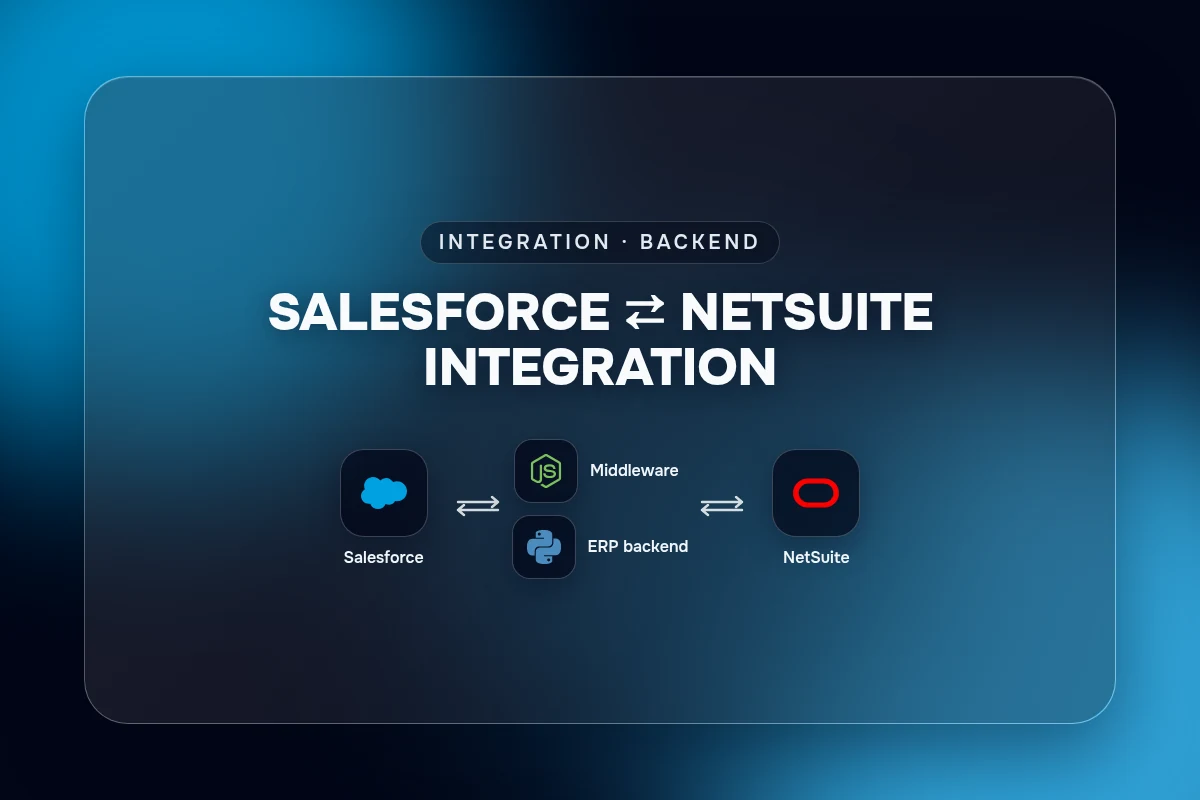
- Original sync backends: Built the Python backend that communicates with NetSuite, the Node.js middleware that receives data from Salesforce and NetSuite-side scripts that detect changes.
- Batch sync client: Sole author of the shared batch client and the account synchronization.
- Opportunity sync: Largest contributor to the opportunity synchronization module.
- Additional modules: Built several of the platform modules and much of its documentation.
Key project features
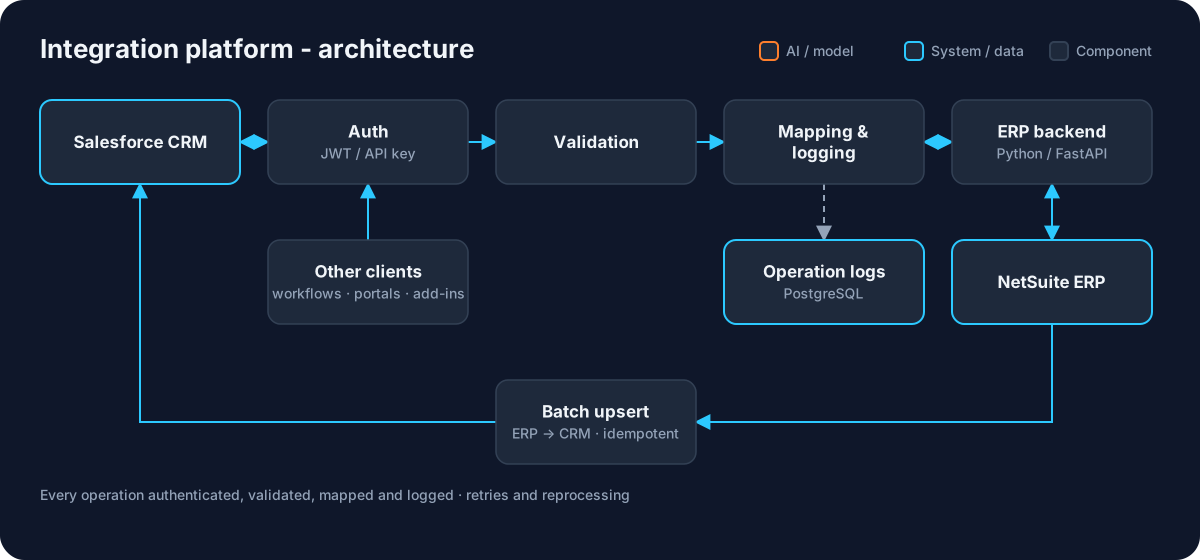
- Integration middleware that authenticates (JWT or API key), validates, maps and logs every operation before forwarding it to the ERP backend or the CRM.
- Opportunities with idempotent create/update and background sync to the CRM.
- Customer, vendor and contact synchronization, plus ERP → CRM synchronization.
- Purchase order expediting notifications and RFQ data endpoints.
- Rule-based expense transactions into the ERP and LLM-based invoice data extraction to strict JSON.
- Operation logs in PostgreSQL for traceability and reprocessing, with error handling and retries.
- CI/CD pipeline that deploys to Azure App Service.
Key evolution
The ERP → CRM sync was migrated from single-record endpoints that caused conflicts to batch, idempotent upsert endpoints keyed by the ERP record ID, with per-record results (multi-status responses) handled through a shared batch client.
Impact achieved
The CRM and ERP stay consistent with fewer sync conflicts, and every client accesses ERP data through a single controlled layer with full traceability and reprocessing capabilities.
Technologies
| Technology | Use / Implementation |
|---|---|
| TypeScript | Typed code for the integration middleware. |
| Node.js / Express | Middleware for authentication, validation, mapping and logging. |
| Python / FastAPI | ERP backend that communicates with NetSuite. |
| PostgreSQL | Operation logs for monitoring, traceability and reprocessing. |
| OpenAI | Invoice data extraction to strict JSON. |
| GitHub Actions | CI/CD pipelines. |
| Azure App Service | Hosting of the platform services. |
Project flow