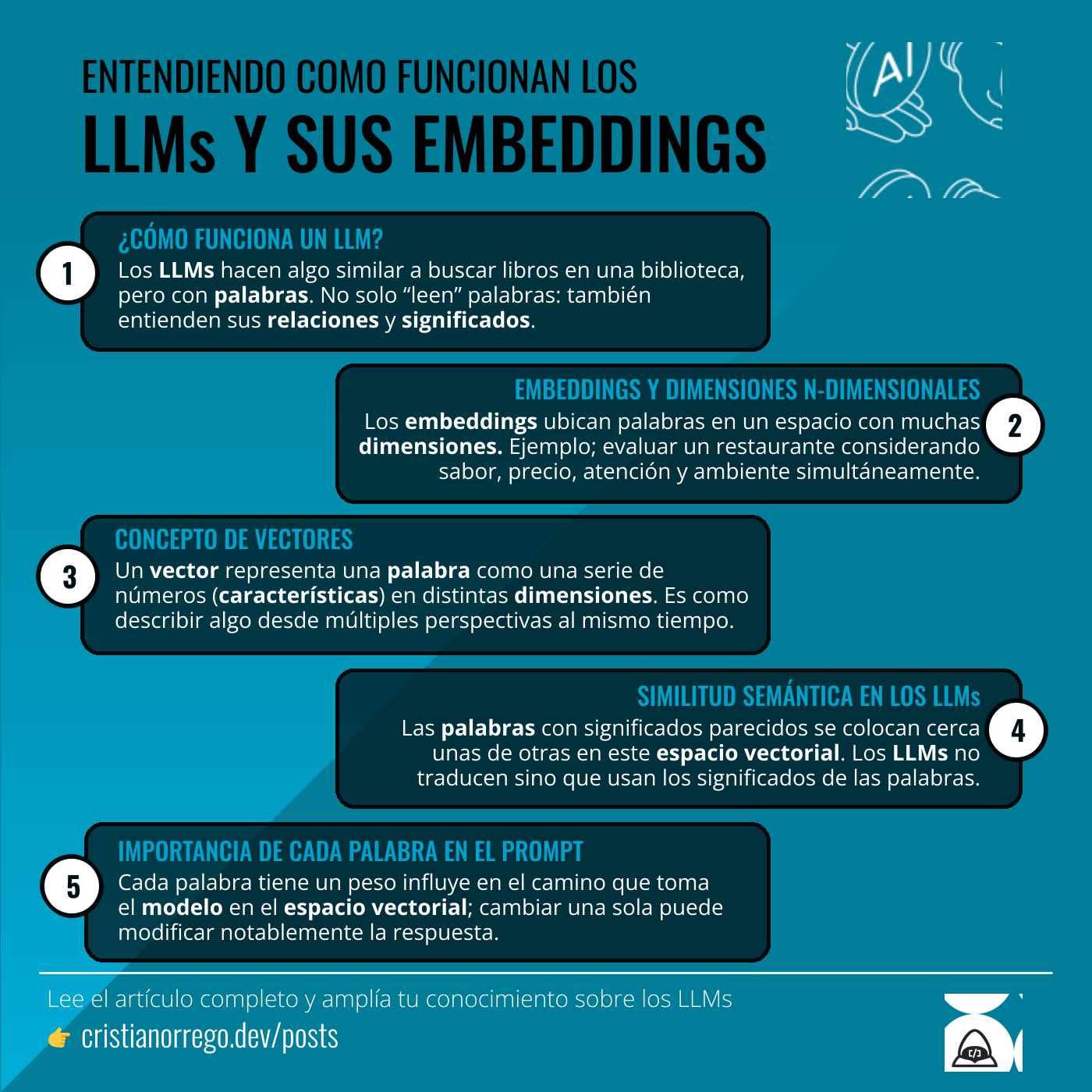
Large language models (LLMs), such as ChatGPT, have revolutionized how people interact with artificial intelligence. Their ability to understand and generate coherent text is deeply tied to two key concepts: vectors and embeddings. With these fundamentals understood, better prompts can be crafted, results can be optimized, and the full potential of these tools can be leveraged.
What are vectors and how do they relate to LLMs?
A vector is, in essence, an ordered list of numbers that describes the position or characteristics of something in a space defined by dimensions. In physics, vectors are often imagined in X and Y coordinates, and with a third dimension: X, Y, Z.
In the case of LLMs, vectors are not limited to 2 or 3 dimensions:
- They can have hundreds or thousands of dimensions.
- Each dimension represents an abstract feature of a word, such as context, grammatical category, or emotional nuance.
Instead of placing a point on a plane or cube, an LLM places words in a multidimensional space where distances and directions represent relationships of meaning.
What role do embeddings play in language understanding?
An embedding is a high-dimensional vector that describes the meaning of a word or phrase. It does not only focus on literal definition, but also on:
- Contexts where it appears.
- Associated emotions.
- Categories and relationships with other words.
Intuitive example:
When evaluating a restaurant, a single criterion is not enough. Considerations include:
- Food quality
- Atmosphere
- Service
- Freshness of ingredients
- Music
Similarly, an embedding evaluates a word across multiple dimensions, allowing a model to understand its meaning with greater precision.
How embeddings connect words across languages
One of the strengths of embeddings is that they map meanings, not just words. For example:
- Aguacate (Spanish)
- Avocado (English)
Both share attributes: fruit, green color, creamy texture. The model can recognize they refer to the same thing even without explicitly translating the word. This happens because both are close in vector space.
Why every word in a prompt is crucial
When writing a prompt for an LLM, every selected word moves the conversation to a different area of vector space.
- Changing a word can move closer to or farther from the expected meaning.
- This modifies the set of semantic relationships the model will explore to respond.
In other words: the precision of a prompt determines the precision of the response.
Conclusions
Understanding how LLMs represent language through vectors and embeddings provides a key advantage. It is not just about "writing a question"; it is about constructing a precise path in the model's semantic space to obtain the desired result.
Infographic